Industrial Experience
Employ an undergraduate student in Computer Science, full-time for a year, before they graduate
Industrial Experience (IE) placements: a full year in industry
Around a third of our undergraduate students are successful in securing employment on an Iindustrial Experience (IE) placement year in industry. This takes place in their penultimate year of study, before they graduate. Placement years are sometimes known as a “sandwich” years because they sit between second and final years of undergraduate study. (Mallon 2026, 2025)
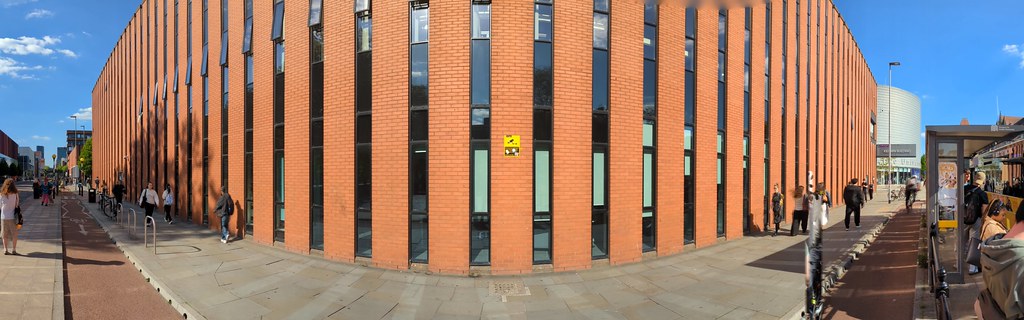
Placements are a mutually beneficial partnership between three different groups of people
- The employer
- The students, as both employees of the employer and students of…
- The University of Manchester
EMPLOYERS: This is a guide to Industrial Experience (IE) for employers of undergraduate Computer Science students at the University of Manchester. So, if you’re an employer, read on.
STUDENTS: If you are an undergraduate student of Computer Science, you must read and understand the requirements in the student guide, which can be found in the placement handbook on canvas.manchester.ac.uk/courses/53119/pages/placement-handbook
ACADEMICS: your pastoral responsibilities as personal tutor to your tutees while they are on placement are overseen by David Petrescu, the Computer Science placement year tutor
The advantages and requirements of IE placements for employers are described below.
Advantages of Industrial Experience (IE) placements for employers
Year long placements are advantageous for employers, while benefiting the students they employ and the University of Manchester because:
- Employers: benefit from a cost-effective way to recruit (and retain) student and graduate talent. Placements can serve as a year-long interview that informs future hiring decisions
- Students: benefit from a broader education while developing their professional skills. These include non-cognitive, softer, social and business skills and attributes that can be harder to learn in a formal and traditional academic environment
- The University of Manchester: benefits from producing better graduates with broader and deeper skills, who get better graduate jobs and earn higher salaries on graduation. (HESA 2025; Greaves 2025)
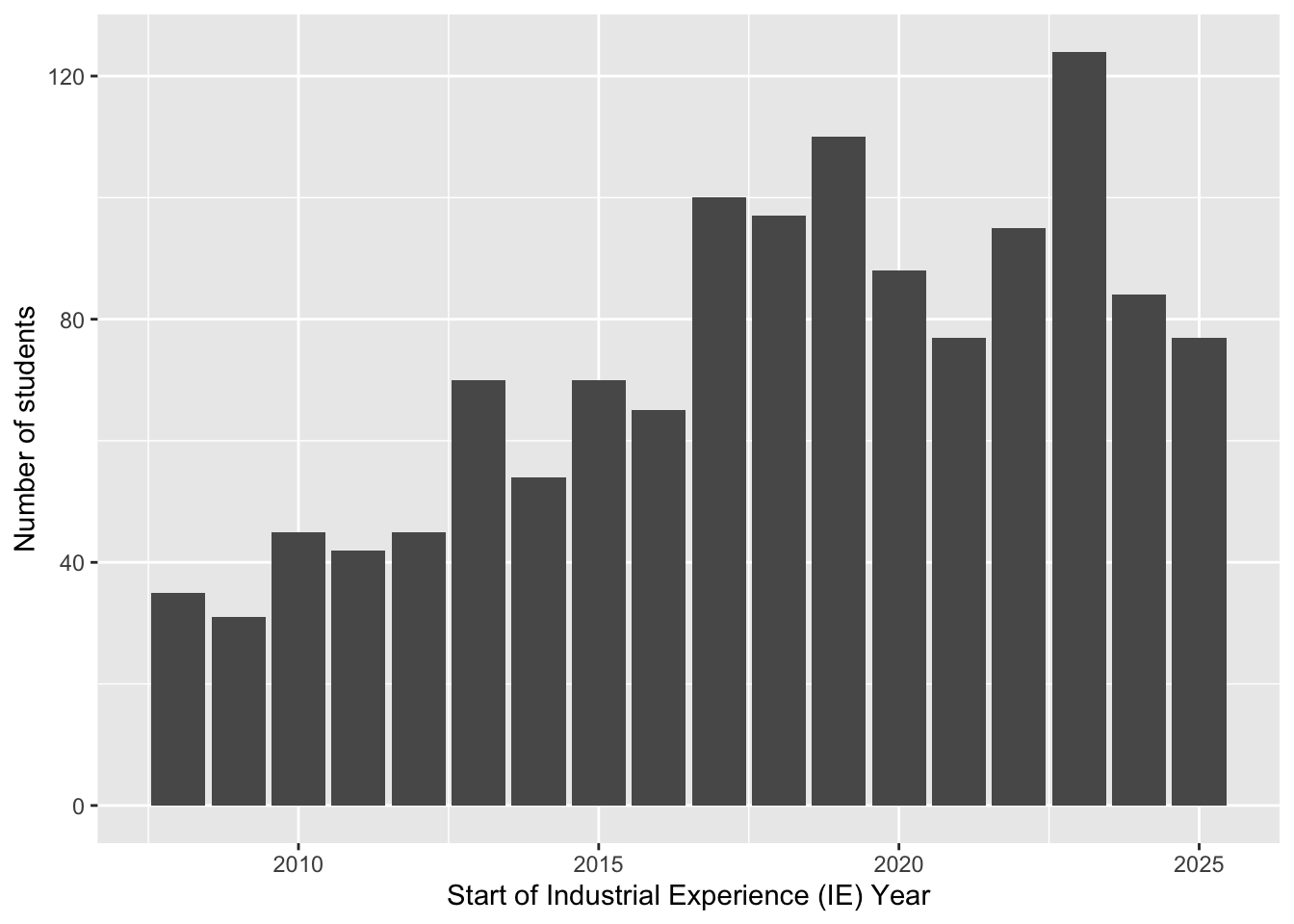
In the academic year starting September 2025, during a challenging job market, (Burn-Murdoch 2026) we have 77 students who started their year long industrial experience (IE) placement as part of their undergraduate degrees in Computer Science. Year long placements have to be approved by our placements team, see contacts. The basic employer requirements before, during and after placements are as follows:
Our requirements of employers before IE placements
The University of Manchester requires that all employers of undergraduate students on year-long IE placements:
- Advertise their placements publicly between September and August. Our second year students start searching for IE placements in September onwards, for placements starting in summer/autumn of the following year. There are lots of options for advertising, depending on who you are targeting and what your budget is including:
- LinkedIn Jobs uk.linkedin.com/jobs
- Gradcracker gradcracker.com
- Trackr the-trackr.com
- Other jobs boards that are indexed by AI chatbots and search engines like jobs.google.com
- An employers own website
- Career Connect at the University of Manchester, (no charge) see employers.manchester.ac.uk/vacancies
- Any of the other places that students can find jobs
- Provide students with a fixed-term term contract of employment. This is typically 12 months, but 9 months (minimum) up to 15 months (maximum) are also possible depending on start and finish dates
- Are covered by Employer’s Liability Insurance, or equivalent if they are outside the UK
Our requirements of employers during IE placements
The University of Manchester requires that all employers of undergraduate students on year-long IE placements:
- Pay students a salary. Salaries range widely from the lowest National Minimum Wage and National Living Wage to the highest at £70k+.1 Placement salaries vary depending on sector and location, but higher salaries often attract stronger applicants. (Anyinsah-Bondzie 2025; Leong 2025)
- Start placements between June and September, to allow students a year of employment before they return for their final year at University
- Provide projects for students to work on that allow them to apply and extend the skills and knowledge they have learned at University
- Some employers provide rotations e.g. two sixth month sub-placements in different parts of their organisation
- Allow their placement students to receive two visits from an academic while on placement, usually their personal tutor. These meetings are remote, but may be in person if appropriate:
- The first meeting takes place in autumn to check the student has started OK.
- The second meeting in spring/summer allows the personal tutor to meet with both the student and their manager(s) to discuss their progress.
- Treat students with respect. Although students may be the most junior employees in an organisation, they should not be treated as the office dogsbody, whose main responsibilities are making cups of tea and running menial errands for their more senior colleagues.
Most placeemnt providers employ their students in the UK. We have a small but significant number of employers providing placements outside the UK, these employers need to make suitable arrangements for their students right to work, if they are not a resident of that country. A good example of this is technical studentships at CERN in Geneva.
Our requirements of employers after IE placements
The University requires that all employers of undergraduate students on year-long IE placements:
- Allow their placement students to write a short report at the end of their employment, which is formatively assessed by the placement year tutor. If their work is commercially sensitive or confidential, placement reports can be subject to non-disclosure or confidentiality agreements that the employer has asked their employee (the student) to sign
- Allow students to return for their final year of study starting in September, after their fixed term contract of employment expires.
It is common for employers to make return offers of graduate employment, if students have performed well during their placement year.
The IE placement program in Computer Science
We have a large and established Industrial Experience (IE) program in Computer Science, which has grown significantly since 2010, see Figure 1
Previously our students have secured year long placements at a wide range of employers including Accenture, Agilent Technologies, Amazon Web Services, AND Digital, Apadmi, Arggo, ARM, Autodesk, AVL Powertrain, BAML, the BBC, Biorelate, BJSS, Bloomberg, BMW Mini, Bsquare Controls, BT, Cantarus, Celtra, CERN, Codethink, d3t, Elysian Systems, Feral Interactive, Fidelity, FiveAI, HMRC, IBM, Imagination Technologies, Intel, ISA Software, JP Morgan & Chase, Keysight Technologies, KPMG, Matillion, McAfee, Mentor Graphics, Monoprix, Morgan Stanley, NCC Group, Nokia, Nomura, Novacoast, Ocado, PA Consulting, PwC, Schlumberger, ServiceNow, Siemens, Soda Software, SteamaCo, The Hut Group, The Start Up Factory, Uber, Visa, Vodafone and many others.
More IE placements at the University of Manchester
Computer Science with Industrial Experience (IE) is the largest elective program of industrial or professional experience at the University of Manchester, as shown in Figure 2. While Medicine, Dentistry and Nursing have more students on placements (usually known as clinical practice), these placements are a compulsory part of professional qualification, rather than an optional and elective one.
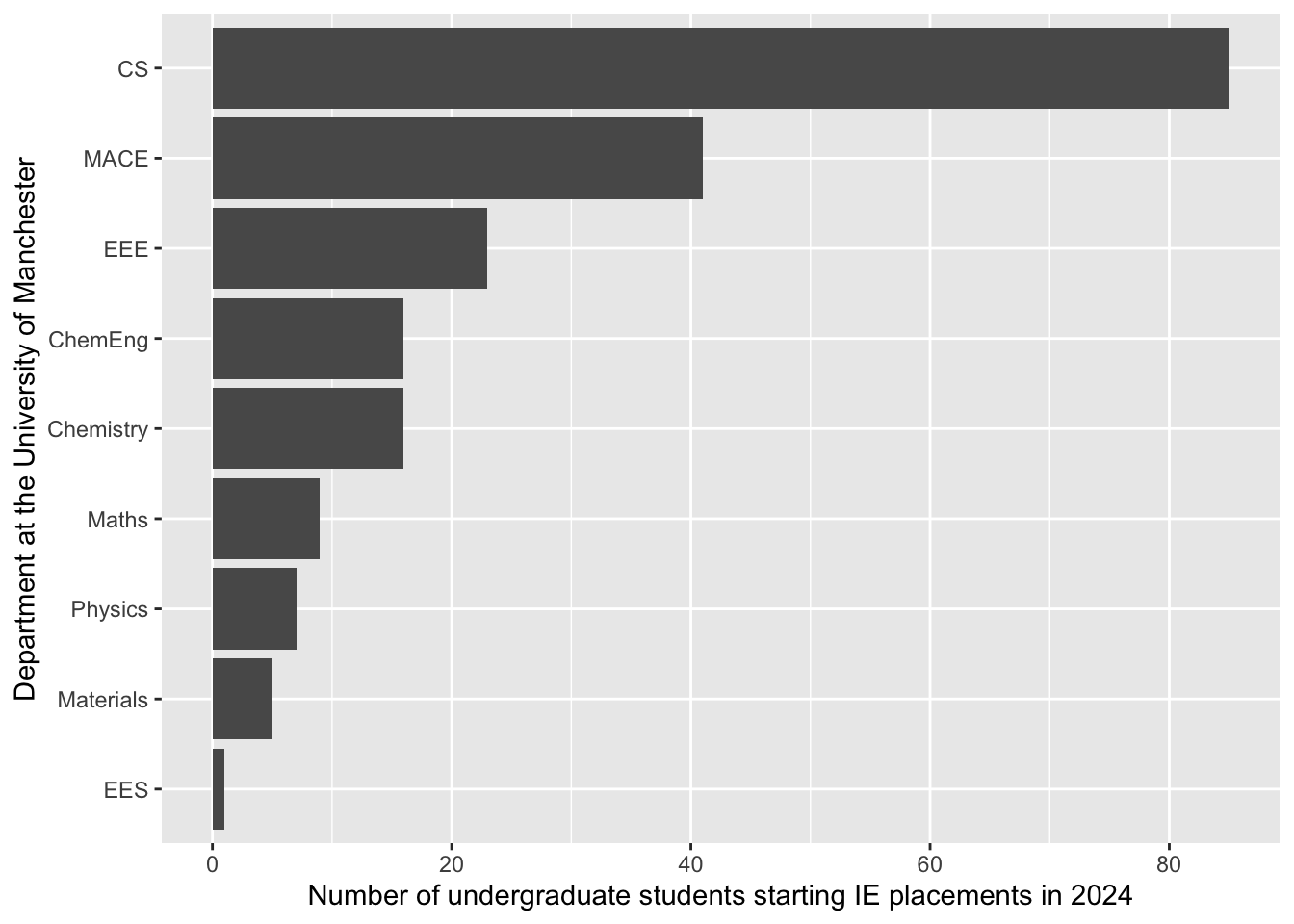
CS: Department of Computer Science cs.manchester.ac.uk, MACE: Department of Mechanical, Aerospace and Civil Engineering (MACE) mace.manchester.ac.uk, EEE: Department of Electrical and Electronic Engineering eee.manchester.ac.uk, ChemEng: Department of Chemical Engineering ce.manchester.ac.uk, Chemistry: Department of Chemistry chemistry.manchester.ac.uk, Maths: Department of Mathematics maths.manchester.ac.uk, Physics: Department of Physics & Astronomy physics.manchester.ac.uk, Materials: Department of Materials materials.manchester.ac.uk, EES: Department of Earth and Environmental Sciences ees.manchester.ac.uk. Data from PowerBI as of 2025, note that summer internships are shown in this bar chart, only year long placements. Data from app.powerbi.com
If you’d like to offer IE placements in Science, Engineering and beyond, see the contacts.
References
Anyinsah-Bondzie, Melchi. 2025. “The Highest Paid Interships and Placements.” https://higherin.com/careers-advice/exploring-options/highest-paid-internships-placements.
Burn-Murdoch, John. 2026. “‘Is University Still Worth It?’ Is the Wrong Question: The Graduate Earnings Premium Isn’t Really Measuring What Most People Think.” https://www.ft.com/content/649d3c64-b8e5-4979-9f0c-9aebd43642e2.
Greaves, Laura. 2025. “What Do Graduates Do? How Graduates Fared After Entering a Labour Market That Had Started to Decline in the Second Half of 2024, Following a Period of Post-Pandemic Growth.” https://luminate.prospects.ac.uk/what-do-graduates-do.
HESA. 2025. “Graduate Outcomes Data for BSc (Hons) Computer Science with IE at the University of Manchester.” https://discoveruni.gov.uk/course-details/10007798/2571195/Full-time/.
Leong, Sam. 2025. “Summer Internship Season Report 2025.” https://the-trackr.com/blog/summer-internship-season-report-2025/.
Mallon, Kelly-Ann. 2025. “What Is a Placement? Information about Placements for Students.” https://www.careers.manchester.ac.uk/experience/placement/.
———. 2026. “Information about Placements for Employers.” https://www.employers.manchester.ac.uk/recruit/placements/.
Footnotes
We ask students to tell us their placement salaries if they are happy to share the information. As of 2026, £70k pa is the highest reported IE placement salary in Computer Science.↩︎